

From feminicide data-inflected visions to feminist visual potencia
Victoria Page and Ren Aldridge. 26/10/2026. First published on Medium for the Data and Feminicide Lab, MIT.
Anti-feminicide art takes many forms, frequently forwarding powerful and creative visual strategies that bring attention to the scale of feminicide, and often embodying alternative and affective ways of visualising feminicide data. Through the Data and Feminicide: Theory and Practice course run by Data Against Feminicide (Datos Contra Feminicidio — DCF), we the authors — Vikki and Ren, met and connected over our shared engagement and interest in creative visualisation practices around feminicide. Drawing directly on examples shared within the course, in this blog we explore forms of data-inflected visions of feminicide, namely the use of silhouettes by different groups and the protest performance, Un Violador en tu Camino by Chilean feminist collective Las Tesis. We ask, how do data-inflected visions of feminicide contribute to the expansion of feminist visual potencia?
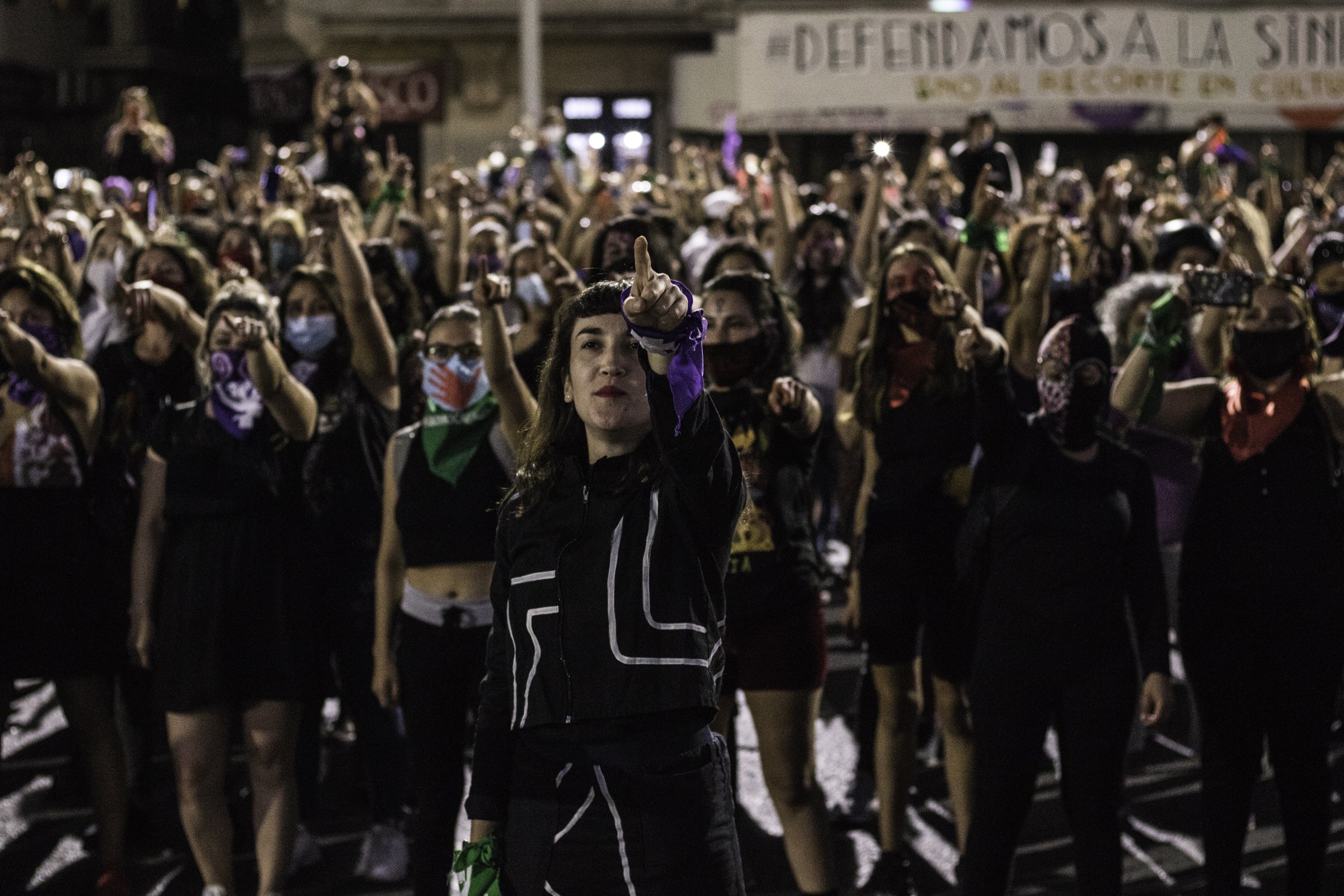
Photo: Un Violador en tu Camino by Camiperezsoto — Creative Commons
Data-Inflected Visions and Feminist Visual Potencia
The concept of data-inflected visions was developed by Helena Suárez Val, one of the course facilitators, who considers ‘how diverse visual representations of an issue (beyond data visualization) may come to be imagined as data, and how doing so opens up different meanings for the affective and the political in data.’ Helena considers that ‘Visual artifacts created by anti-feminicide activists’ are, in their diverse formats, forms of data-inflected visions. During the course, Helena invited us to post examples of data-inflected feminicide artefacts onto the course forum, and it is from this collectively accumulated resource that we drew the examples we discuss here.
Feminist visual potencia draws on the notion of potencia — a concept that in recent years has gained popularity within feminist and Latin American social justice arenas. Argentinian scholar and activist Veronica Gago defines feminist potencia as an affective form of power, rooted in the body and that expands the capacity of what people are able to do .
Bringing a specifically visual aspect to the notion of feminist potencia, I (Vikki) have been researching how visual and creative activism influences feminist potencia around anti-feminicide activism in Mexico and Brazil. Within both concepts above, the affective reverberations and emotional encounters are key, providing the energy or fuerza (force) that moves and mobilises people into feminist actions against feminicide.
Method
Bringing both concepts together, we looked through the data-inflected artefacts collected on the course forum and chose those that resonated most with us; those that provoked an affective response, following Helena’s description of the way in which different data-inflected visions “may vibrate differently through different bodies, contexts and times”. Rather than selecting those which had the strongest affective impact on us, we chose to focus on the works that vibrated at the level of potencia — that sparked something in us. The following details how we experienced the affected vibrations of feminist visual potencia in the data-inflected visions that we each chose.
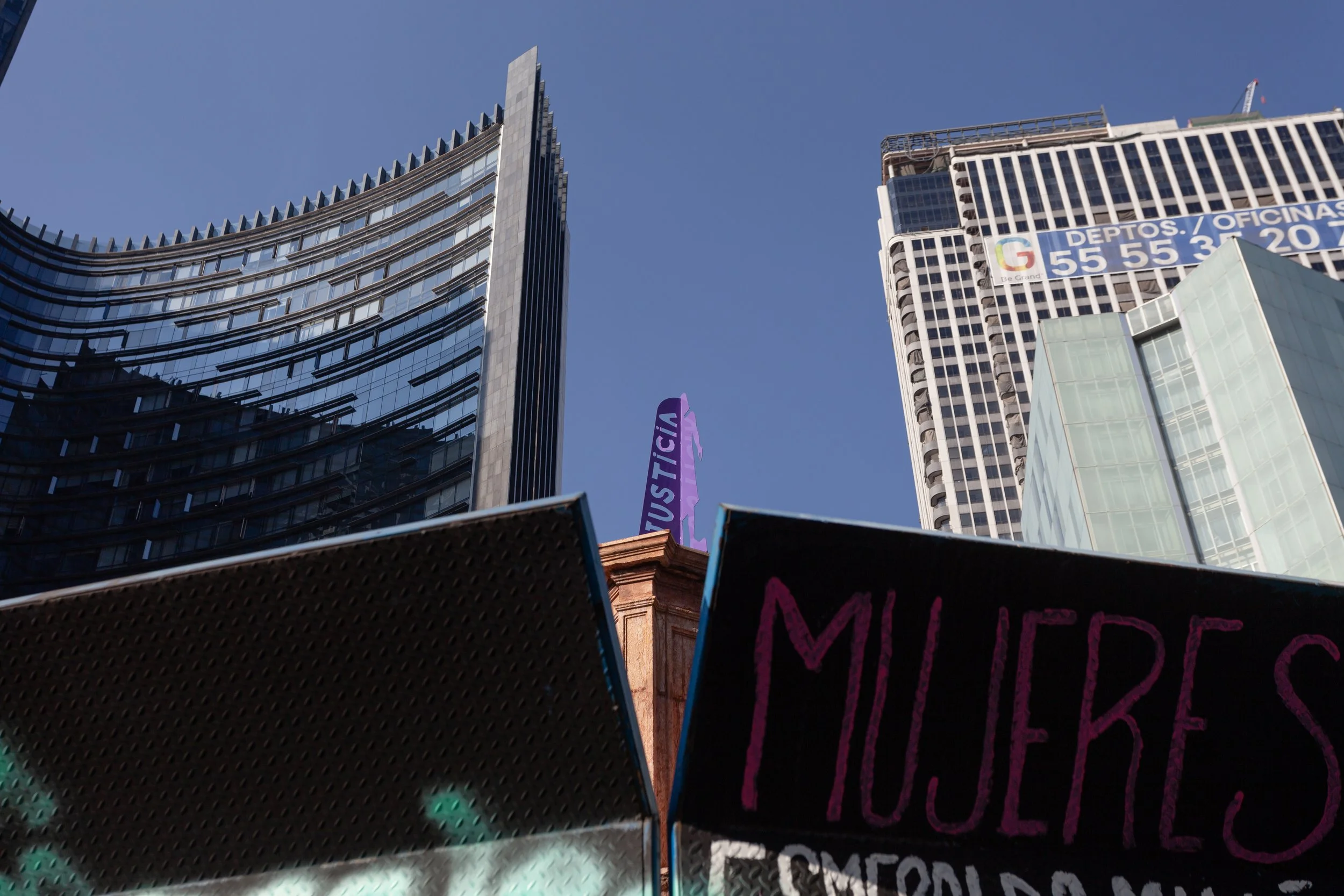
Photo: Victoria Page
Traces of Feminicide: Silhouettes (Vikki)
I first came across the silhouettes in Mexico City at the Glorieta de las Mujeres que Luchan. A purple cut out of a girl with her fist raised in the air took the place of what had been home to Christopher Colombus, in prime location on top of a plinth in one of the main roads in the centre of the city. Justicia in a stencil cut out ran down the spine of her back. I felt that warm wash of inspiration run through me on sight of her. The sense of feminist possibilities and creative potencia turned palpable in that encounter. Maybe because she towered over the city, defiant, maybe because as I looked up to her, the force of that image made me believe, even momentarily, that something else was truly possible.
I traced the outlines of her, trying to identify her. After the first sighting I kept seeing her throughout the city, repeated again and again just like the stories of feminicide were. Those stories, ones that I engaged with for my research, redefined the spaces and places I travelled through. The kidnapping of Maria Ángela Olguín just before I arrived in CDMX, in the middle of the day from inside the metro, kept appearing in my vision and pressed down on me whenever I entered the stations — my body twisted and contorted trying to fold in on itself and make itself unnoticeable or as small as possible. Fear. Then on seeing her, that purple girl, reappearing in white, against walls and other surfaces, would allow something else to come through, a different vision, a possibility of something else, of being sin miedo (without fear), a spark of feminist potencia.
One of the silhouettes projects shared in the forum, the Mural Against Feminicide in Rome, Italy, takes the form of an interconnected chain of people painted in white around a wall painted in red, led by artists Via dei Sardi and Via degli Enotri who come together under the WaW Duo and in reference to women murdered by men in Italy between 2012–2013. The second project mentioned is that of Las Que Ya no Estan created in Costa Rica in 2022 by the Ministry of Justice and Peace as a campaign against feminicide with the participation of family members of women killed the year prior.
The silhouettes are a powerful aesthetic that speak to the ausencia (absence) of individuals. Famously used by the Madres de la Plaza de Mayo in Argentina during the military dictatorship to protest the disappearance of family members, silhouettes have been used across countries in response to feminicides and desapariciones (disappearances) since. Those, like the second project states, que ya no estan (that are no longer here), reappear, are made present again, taking up space and refusing the process of invisibility which reinforces the dynamics of feminicides. Feminicide data can be understood as the record of the presence of violence in the past and the absence of a woman today — no estamos todas (we are not all here). The silhouettes enable another way of engaging with this. The body, the idea, the abstract outline of a form makes women’s absence present — visible.
Connecting to struggles that are historic, transversal and transnational, the silhouettes, used across countries, rather than solely rooted in individual or isolated cases, produce a vision of violence that is social, structural and systemic. Whilst differences in inequalities influence and expose groups to varied precarities, any woman can be killed at any time — none of us are immune from this possibility. A notion we come to understand through the silhouettes. One day, they may stand in for me, you, her…us.
The individual and the collective come together. In both examples, the silhouettes were named, a figure for each individual. Behind each figure, or like each number in a data set, there is an individual woman. Whilst the nameless figure, abstracted, allows the possibility to project onto it any victim of feminicide, by naming, giving an identity brings us back to the body, the person and their absence. These creative visual interventions humanise. Whilst both are based on data sets of specific time frames, feminicide data is not composed of empty numbers — but each number, a distinct life who is in these examples, recognised and remembered. People are not reduced to numbers nor are cases of feminicide reduced solely to individuals.
Scale comes in the repetition — along the length of a wall as far as the eyes can see, or reappearing across public spaces, or there again across countries and decades. With that said, the question of intersectionality is important here. The repeated outlines, uniformly presented whilst seeking to encompass all women, often reinforce a particular narrow image of a woman. Women of diverse backgrounds, Black women, disabled women, trans-women, those from different religious and ethnic backgrounds, are to some extent, whitewashed. The choice for standardisation removes differences in favour of a singular symbolic silhouette. A type of disaggregated data.
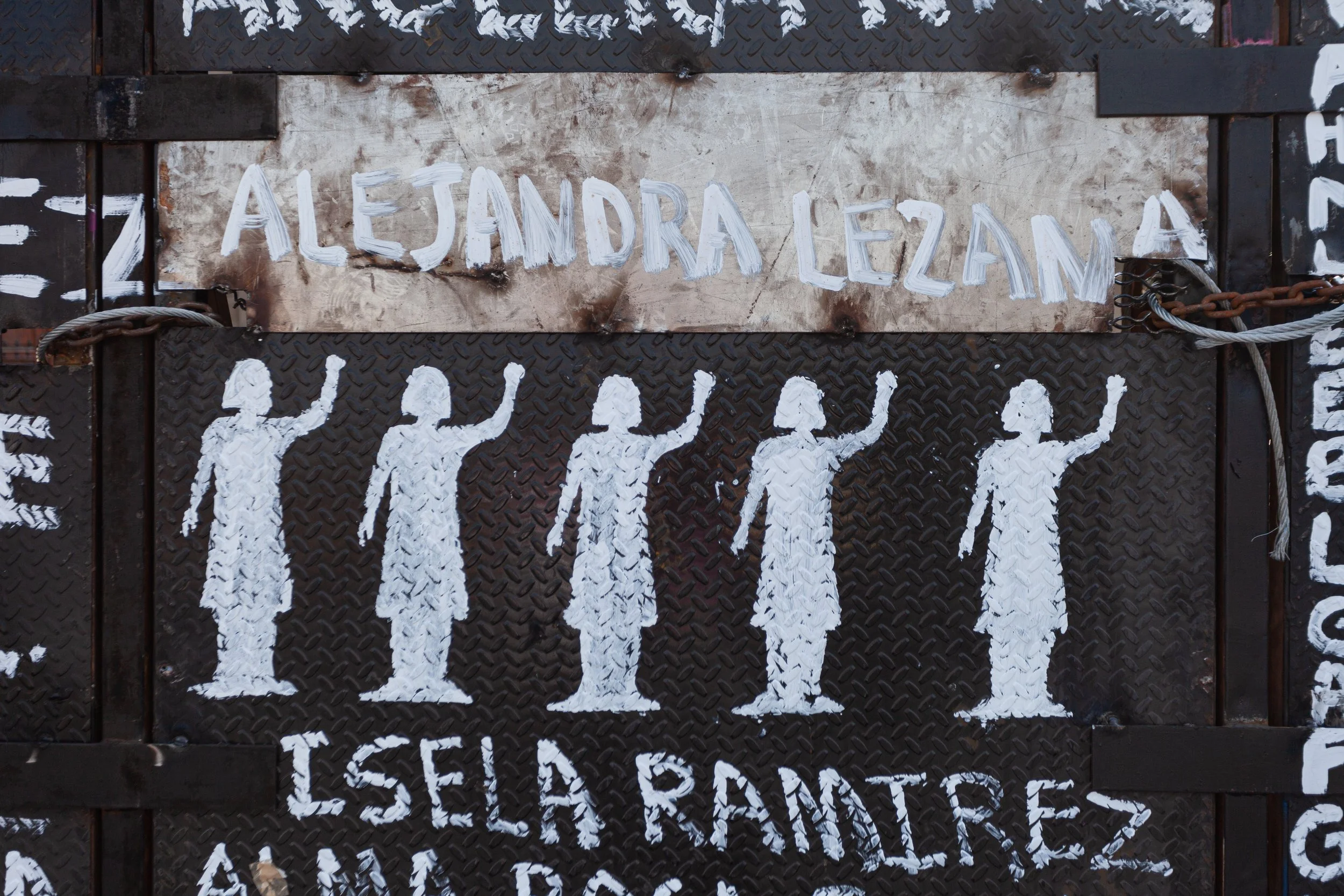
Photo: Victoria Page
Protest Performance: Las Tesis (Ren)
I (Ren) felt the swell of feminist potencia most strongly in relation to a video of protest performance Un Violador en tu Camino performed by Las Tesis Senior, and an accompanying photograph from fellow course participant Emilia Seissus Ercilla, who described taking part in this performance with her mom and sisters. Un Violador en tu Camino is a protest performance created by Chilean collective Las Tesis in 2019, and replicated by feminist collectives all over the world. The version that Emilia shared on our course Forum, Las Tesis Senior, was organised by older women and has an extra bittersweet resonance as a demonstration of intergenerational solidarity. Reading her post, I was particularly moved by the way in which Emilia described her mom’s strength. I felt both sorrow and power. It reminded me that the collective strength we feel, when we gather in this way, emerges from so many different lives and stories across the generations.
It is the combination of sorrow and power that is key to my personal experiences of Un Violador en tu Camino. I have taken part in versions of the performance here in Graz, Austria and written about it multiple times. Even just watching videos online, every single time as the collective voices begin to chant over the beat I feel myself inhale sharply and my eyes sting — an affective embodied reaction that occurs involuntarily. Sorrow is part of it, but so is anger and a sense of deep connection in which I viscerally feel collective power and am moved towards action.
This is an example of what we are calling feminist visual potencia — catalysed through a creative performative action. In Un Violador en tu Camino, the potencia in our individual bodies is catalysed by our coming together as a collective body; as groups of women and genderqueer people gather in defiance of the systemic violence that shapes each of our lives in different ways. Distinct individual bodies at which this violence is directed, many of which carry experiences of violence, move together, and distinct voices emerge from the vocal chords of individuals united as a chorus for a few minutes.
Similarly to the way that the silhouettes carry the suggestion that they could come to represent any one of us (whose gender expression puts us at risk of feminicide), when we perform Un Violador en tu Camino, we momentarily perform different forms of gender-based violence, including feminicide: “Es femicidio/ Impunidad para mi asesino” (It is feminicide, impunity for my killer). During this line, we squat in the position that Chilean police would force detainees to take, particularly women and girls, when being searched (see Martin and Shaw 2021). This combined lyric and movement express the horror and injustice of feminicide and police violence, but, crucially, we do not dwell there. Our bodies shift into a faster movement as we defiantly refute victim blaming through the repeated line: “Y la culpa no era mía, ni donde estaba, ni cómo vestía” (And it was not my fault — not where I was, nor how I was dressed) before reaching the chorus in which we point (literally) to where the culpa (fault) truly lies: the police, the justice system, the president and the state, then “you” — pointing into the crowd, simultaneously threatening individual perpetrators and reminding us that we, collectively, uphold the structures that enable this violence, and therefore that we, collectively, can tear them down.
Conclusion
Data-inflected visions and feminist visual potencia can be seen as manifestations of feminist refusals to accept feminicides and the impotencia (powerlessness) they provoke. There are other ways in which feminists strategically and creatively transform the imprints of violence into affective art — often public, collectively made and emerging out of pain, rage and a desire for a transformation of the conditions that enable the cruelty of feminicides to take place, again and again. These examples demonstrate just some of the ways in which this is resisted through feminist visual potencia. Creative visual actions such as interventions with silhouette figures or the mass choreographed movements of Las Tesis put our bodies at the forefront — individual and collective at the same time. It is through our bodies that the affects of feminicide reverberate as the possibility of our own potencia emerges. A focus on potencia is not to disavow the horror of feminicide. It is instead intended to draw attention to how within such violence and cruelty, creative collective feminist action continues to open up possibilities for different realities and futures — for futures free of feminicide.
Find out more about the Data and Feminicide Lab, MIT here: https://dataplusfeminism.mit.edu/